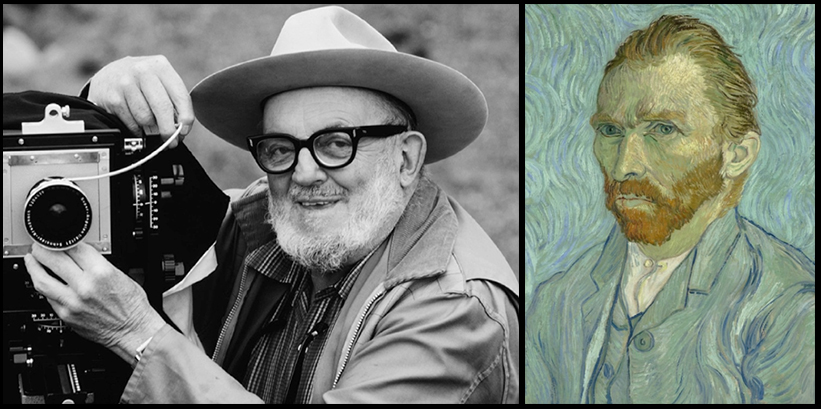
Both photographers and painters pursue the visual arts. They each see the beauty of the world as something to be captured and embraced either on canvas or paper. One group may use paints and brushes, while the other holds a camera and tripod. However, the differences are far greater than this simple assortment of tools and a physical platform.
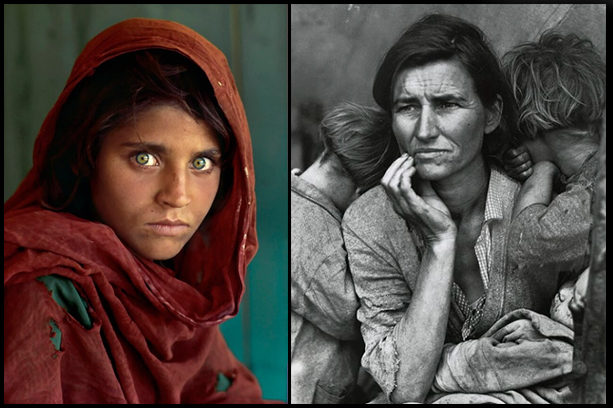
Consider my two favorite photos above, “Afghan Girl” by Steve McCurry and “Migrant Mother” by Dorothea Lange. Each photographer spent hours walking through troubled places encountering many people in need. At some point in time, they met the subjects of their day. Lange then talked with the mother, while McCurry interacted with the young girl.
Each photographer spent at least one day out walking, exploring, and evaluating many possible subjects for their cameras. After many miles and several possibilities, they finally focused on one captivating little girl and a troubled mother.
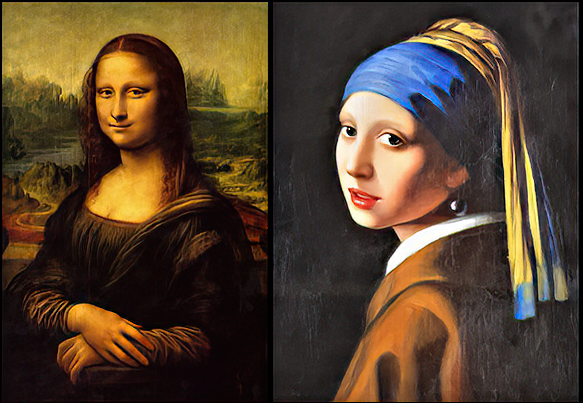
Now Consider two of my favorite paintings above, “Mona Lisa” by Leonardo da Vinci and “Girl with a Pearl Earring” by Johannes Vermeer. In each painting the artist spent many hours with the young woman who remained reactively silent and still during the entire painting. There was minimum talking and movement while the painter strove to capture and portray the inner thoughts of the model.
There are obvious artistic comparisons and similarities between the two sets of images. All four involved women with engaging faces. One can actually perceive the emotion or tensions within each subject that the artist captured. Each person that views the two photos or two paintings feels that they in some way actually know the subjects.
However, there is much more to examine and understand with the comparisons of the painter and the photographer. In order to examine this issue further, let’s look at images that do not involve actual people.
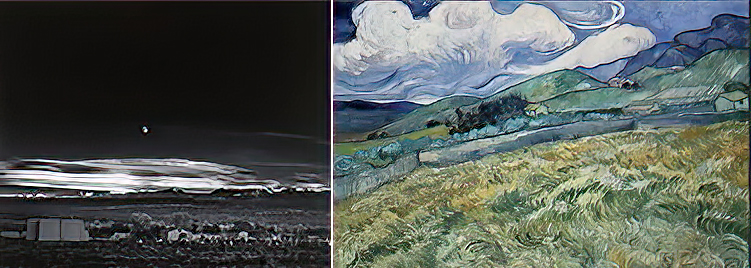
Consider the two landscape images above. The first is “Moonrise, Hernandez, New Mexico” by Ansel Adams, and the second is “Landscape at Saint-Remy” by Vincent van Gogh. In “Moonrise,” Adams spent the day walking around New Mexico with his camera and tripod in search of the ideal location for this dynamic image. After several hours, he settled on a spot and snapped his shutter.
As for Van Gogh, he went out to a field near his home, set up his canvas and chair, and then began to paint. He spent most of the day, and perhaps part of the following, with his brush in hand.
The Ultimate Issue
The underlying and profound distinction between these two approaches to the visual arts obviously deals with the artist’s relationship to the brush and the shutter. However, it perhaps in some ways has more to do with issues that are outside the arena of art.
The fundamental difference can be said to have more to do with the discipline of psychology than that of art. From a personal perspective, I view my camera as my unique and private tool that enables me to travel the world and interact freely with perfect strangers. It also gives me a purpose to spend the day walking through the countryside to witness its beauty. The camera allows me to meet and know my subject, and then to capture its beauty. For the photographer, the camera, like the family dog, cries out each morning to be taken for a walk.
In contrast, painters relish the solitude of the studio. Its stillness and peace serve as the medium for the painter to envision the art. This art is an internal quiet force striving to be exposed on a canvas with the assistance of a caring brush.
Stated very simply, this distinction can be most easily labeled by two terms: Introvert or Extrovert. This is not saying that the painter is an introvert, while the photographer is an extrovert. The reality is that these artforms possess these two fundamentals of psychology. Painting is a introverted art, while photography is an extroverted one. The painter’s world is one of solitude and patience, while the photographer exists in the noise and chaos of the street.
The world of art embraces these two approaches to showcase the beauty we call visual art. Whether captured in the peace of a studio or the chaos of the streets, the images each cry out for the viewer to witness and interpret their inner beauty. The painter and the photographer coexist with each devoting their lives to this eternal pursuit. The world of art requires both the camera and the brush!